

How to Cut Silk Ribbon for Wedding Invitations
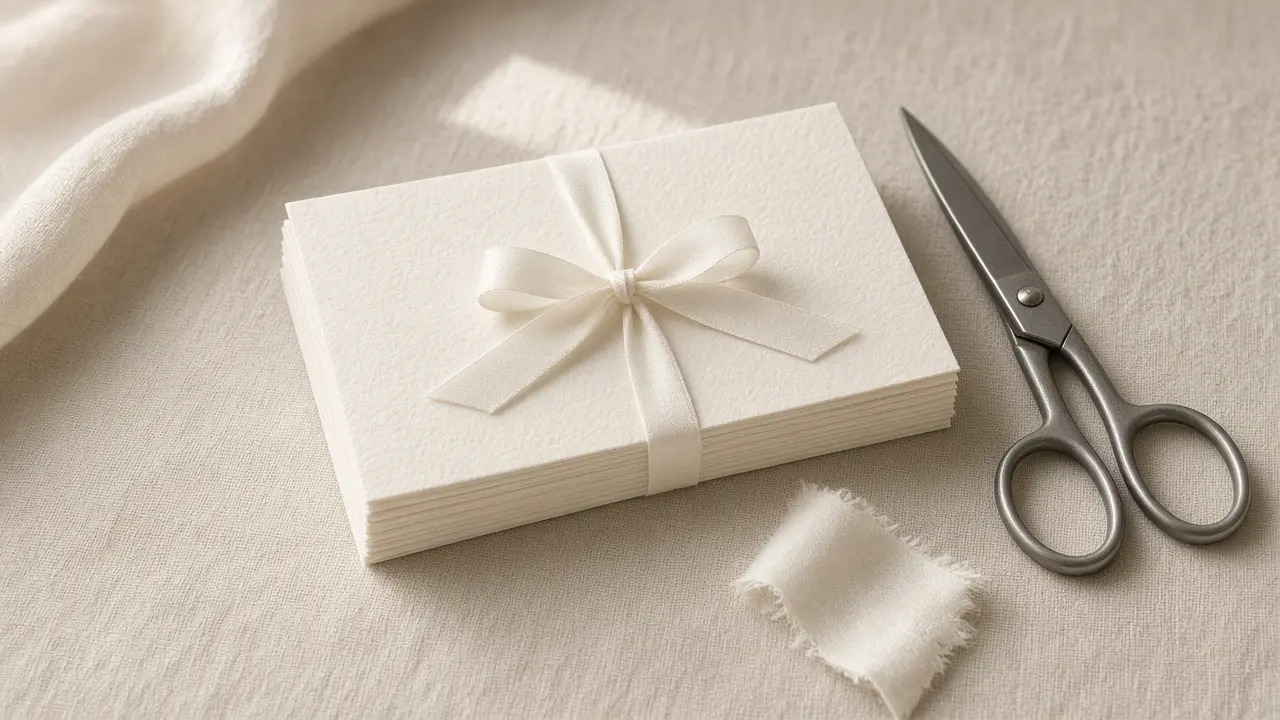
Cut the tails once, on an angle, with shears that finish the width in a single snip. That is how to cut silk ribbon for wedding invitations when the edge is supposed to look finished. If the ribbon was torn from the cloth on purpose, stop fighting the fringe and pull the loose threads instead.
Do the test on a scrap before you touch the spool you ordered for the guest count. Silk and satin fail in different ways, and a lighter that "works on ribbon" is usually being demonstrated on polyester.
Name the ribbon before you cut it
Finished habotai, a tight plain weave with hemmed or woven edges, wants a crisp tail. Hand-torn silk gauze and many linen ribbons are sold with a soft fringe already in the edge. The Lesser Bear's ribbon is torn by hand, and the loose threads that appear as you unwind the spool are part of that process. Dinglewood treats linen the same way: a sharp start, then a little fray left on purpose, or even pulled out by the shorter crosswise threads if you want more of it.
Satin and grosgrain are a third case. Their fibers melt. A quick heat seal can stop a satin tail from combing out. The same flame on silk leaves a scorch. If you are unsure which fiber you bought, burn a one-inch scrap over a dish, outside the stack of cards. Silk smells like hair and leaves a crushable ash. Polyester melts into a hard bead. Do that once, then put the lighter away for the silk.
Width changes the cut more than color does. A half-inch habotai, the width Nettle and Silk uses for a delicate wrap, is easy to cross in one snip. A two-inch ribbon needs longer blades. Office scissors that stop halfway through the width leave a notch, and the notch is where the fray starts.
How to cut silk ribbon for wedding invitations in one snip
Lay the ribbon flat. Do not stretch it while the blades are in the cloth. Pulling sheer silk while you cut is how a clean line becomes a run.
Corinna vanGerwen's wrapping note is the mechanic that still holds: a straight cut follows the grain, so the threads loosen together. An angle near 45 degrees staggers them. One quick snip beats a slow chew. If the line looks crooked, cut a new angle a little farther up. Do not try to shave the first cut into shape.
For a swallowtail, fold the ribbon in half along its length, then cut from the fold toward the open edges at that same angle. Unfold, and the V is even because both sides were one cut. Practice on a dull scrap. A wide silk shows a bad V more clearly than a narrow one.
Hold the work taut if your hands shake the line. Place the tip flat between two fingers, pinch farther down with the other hand, and slide until the ribbon is smooth. Cut between your hands, not through them. Fabric shears reserved for ribbon stay sharp. Paper dulls them, and dull blades crush silk instead of slicing it.
The Lesser Bear's practical test for scissors is simple: the blades must cross the whole width without a second bite. Any long, sharp fabric shear will do. Pinking shears are a different look, a zigzag, and they chew sheer silk. Skip them on habotai.
Leave the raw edge when the ribbon is raw
If you ordered hand-torn silk, sealing the long edges is how you erase the reason you bought it. Loose threads along the length come off with a gentle pull, the way the maker describes. Work over a bare table. Threads love dark cardstock and then show up under foil.
When you trim a tail on torn ribbon, still use a sharp angle, then stop. Let a short fringe remain. Yanking the tail to "even it up" unravels more than you planned. Nettle and Silk warns that a hard tug while tying is enough to fray many silks. Snug is enough. The card should not bow.
Intentional fringe on linen is the opposite move, and only on linen or a ribbon already torn: after a clean cut, tease the short crosswise threads until the end looks soft. Do this on a sample and decide if you like it before you repeat it eighty times. A frayed tail inside a small envelope can also shed into the gum.
Tie it flat, then trim
Wrap the main card first so the ribbon has a firm core, then slide the thinner enclosures under the band. Dinglewood's order keeps the reply card from being the thing the knot crushes. Measure that full stack. A length that fit the invitation alone will cinch once the details card is added, and a cinched knot creases cotton.
Center the cross. Tie a single flat knot or a compact square knot. A bow looks right on a table and wrong after a sorting machine. The loops collapse, and the extra bulk can jam or simply make the suite too thick for the envelope you already bought. If you want a bow, use it on suites that travel in a rigid box or that you will hand to guests. For the mailed set, cross the tails and set a low seal, or stop at the knot.
Trim after the knot is tied, not before you know where the knot will sit. Angled tails should be long enough to see and short enough that they do not fold back on themselves inside the envelope. Two matching angles look finished. One straight and one diagonal looks like a mistake.
A wax seal on the cross is optional. Keep it low. The same bulk rule applies to wax as to bows. Premade adhesive seals are sometimes plastic rather than wax, which Nettle and Silk flags for anyone who cares what the guest is actually breaking. Our monogram wax seal notes cover die size and flexibility. The ribbon cut is a separate decision from the stamp.
Press wrinkles before you measure
Silk that sat in a knot in the shopping bag will not cut straight, because the fold lifts one side of the blades. Iron on medium with a press cloth, or run a flat iron along the ribbon while you keep it moving. The Lesser Bear uses both, and says to spritz plain water only for a stubborn crease. Do not soak naturally dyed silk. Residual dye can move, and flower-food packets in a vase are a known way to shift color if this ribbon later goes on a bouquet. For invitations, water is a wrinkle tool, then the ribbon has to be dry before it touches letterpress or foil.
If you like a crinkle, mist lightly, scrunch, and hang to dry before you cut lengths. Crinkle after cutting and your measured pieces come out short.
One suite in the envelope is the real proof
Cut five pieces, tie three, and put one finished stack in the outer envelope you plan to mail. The flap should close without a mound at the knot. The corners of the card should not hook. If the tails overlap the gum, shorten them. If the ribbon forces you into a larger envelope, decide that now, while the spool can still be cut shorter and the envelope order can still change.
Ribbon also changes the weight. Dinglewood's mailing note is the right last step: take one finished, unsealed piece to the post office and have it weighed before you buy stamps for the whole list. Our postage guide walks through thickness and extra ounces. A beautiful tail that turns every invitation into a parcel is an expensive surprise.
Width, fiber, and whether you are mailing or boxing all sit upstream of the scissors. The styling differences between silk, chiffon, and velvet are in silk and velvet ribbon for invitation suites. Belly bands that are paper or vellum, not cloth, are a different assembly and live with the belly band treatment. If you would rather not cut a guest-count spool at the kitchen table, ribbon and seal add-ons can be specified with the suite so the length and the knot are done before the box reaches you.
A short bench order before the full spool
- Name the fiber. Finished habotai and satin get one angled snip. Hand-torn silk and linen keep a short fringe, and loose threads come off with a lengthwise pull.
- Press wrinkles on medium heat with a press cloth, then let the ribbon dry before it touches letterpress or foil.
- Wrap a scrap around the full stack, knot it flat, and only then mark the cut length, including both tails.
- Cut every guest piece with one 45-degree snip. Recut a bad angle farther up the ribbon. Do not saw it.
- Tie the flat knot, trim the tails so they clear the envelope gum, and weigh one unsealed suite before you buy stamps.
Keep the shears for fabric, the sample in the envelope, and the lighter off the silk. The rest of the order can follow that one piece.